search site
countries
all panoramas
BreendonkLa Réunion
Corregidor
Oreshek
Hiroshima
Nagasaki
Hiroshima Dome
Hiroshima Ceremony
Okinawa battle
Okinawa landing
Yasukuni-Jinjya
Manzanar
Tokyo I
Tokyo II
Tokyo III
Pearl Harbor
KL Stutthof
Hürtgen forest
Sant'Anna Stazzema
Stuttgart
Creux-du-Van
Bunker Valentin
Theresienstadt
St-Gotthard railroad
Berlin - Memorial
Roma
Oradour-sur-Glane
Moscow
Al Alamein
Antwerp
Tallinn
Trieste
Hendaye
Coventry
Ebensee
Bastogne
Toulouse
Skæring Hede
St.Petersburg - Nevsky
London
Rab
Maloyaroslavets
Reims
Auschwitz Birkenau
Vienna - Heldenplatz
Gernika
Ryvangen
Vienna - Flaktowers
Nemecka
Brestanica
Maribor
Berlin - streets
Metlika
Hartheim Castle
Ljubljana
Cerkno
Drazgose
Yad Vashem
Berlin - Cenotaphs
Little Haldon
St.Petersburg
Babi Yar
Walcheren
Lommel
Dachau
Arnhem
Hanstholm
contact
e-mailRSS / RSS2 / atom
Breendonk
From belgium 7 panoramas by
Breendonk concentration camp and human rights memorial
Fort Breendonk, located in the centre of Belgium, is one of the smallest concentration camps of ww2 and, because of its size, probably also one of the worst. With an average of 400 inmates there is here 1 guard for every 10 prisoners and the beating and persecutions are continuous from the Flemish SS.
60 years after he left the camp, a survivor of Breendonk comments: “after several months spent in Breendonk I was transfered to Buchenwald, upon my arrival there I was relieved, I felt almost saved, I now had a chance to survive”.
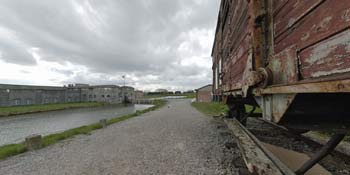
Fort Breendonk
The passageway to the inmates rooms. The inmates are sorted between Jews and non-Jews, there are cells for the “Arrestant” these prisoners don’t work they are at disposal for interrogation by the Gestapo. They spend their day in their room or in solitary confinement cells waiting.
It is always cold and humid here. At the end of the corridor is the bunker: the interrogation room.
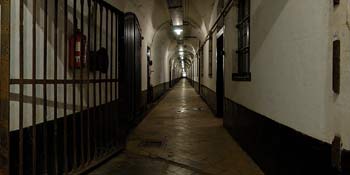
Passageway to the rooms
Walter Obler from Vienna, a calm and simple workman fond of opera. Socialist, revolutionnary and Jew, he fled to Belgium after the Anschluss. From a normal prisoner he turned into a nightmare for his fellow inmates.
The camp commanders cynically promote him (a Jew) to chief of barrack room and labor inspector for all prisoners, Jews or non-Jews. He hits them, beats them and kills some.
Transfered to Auschwitz and Mauthausen in 1943, he survives those camps. In 1945 he becomes member of the antifascist association of the concentration camps prisoners. Recognised by 2 former inmates he is arrested in Vienna and executed in 1947 for the co-murder of 10 at Breendonk.
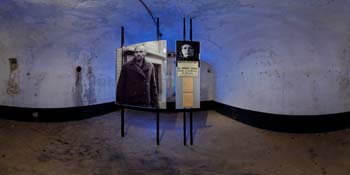
Zug1: the Jews’ room
Inmate #475 François Vander Veken after 5 months in Breendonk.
1 September 1942 he is arrested with 38 other postmen from Brussels. They refused to collaborate with the german censure, they intercepted letters of denouncement, searched German mail and organised the distribution of the underground press.
One of them was executed almost immediately. Because of the beating and ill treatments of the Flemish SS, five other postmen won’t leave Breendonk alive, all deceased in less than a month of their imprisonment.
René Hermans (small pictures) is a brute, promoted chief of barrack room because he is not one of them. The postmen are quick to identify him as an informer. Condemned and executed in 1947.
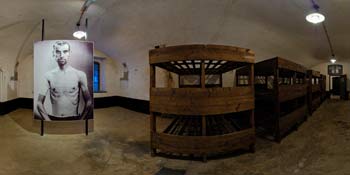
Zug 7 : the postmen room
This torture room is created in 1942 for the interrogation of the resistants. Sessions may last up to 5 hours and the door is always left open to let the other prisoners hear. The hallway sometimes serves as a waitingroom.
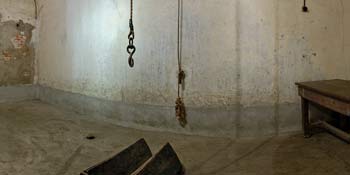
Interrogation room
Another cold and humid passageway. The prisoners walked these corridors with their heads bagged on their way to the showers or the interrogation room they weren’t told their destination.
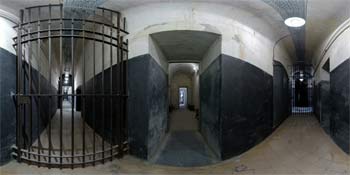
Gates
1941: the showers are operational for the prisoners, the reason being that the SS fear the epidemics for themselves. Once a month, a 1minute flush of water per inmate not more.
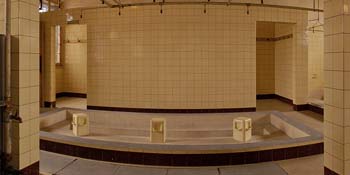
Bathroom
I could have been a hero
I became a torturer
I beat to death the hero I could have been
I beat him into a hero
beat myself into a monster
from the kapo, a poem by Stefaan van den Bremt
© 2005 Mickael Therer 360days | Breendonk memorial
Related websites
Fort Breendonk official website
Holocaust encyclopedia in English, in French
A teacher’s guide to the holocaust
The drawings of Wilchar prisoner at Breendonk in 1943-44
The propaganda pictures of Otto Kropf new edition 2005 available
I wish to thank the staff at Fort Breendonk, and specifically Olivier Van Der Wilt the curator who endorsed this project.
Visit Fort Breendonk for real if you have the occasion, these pictures are no substitute.